The Modern Tech Stack for SaaS Products in 2026
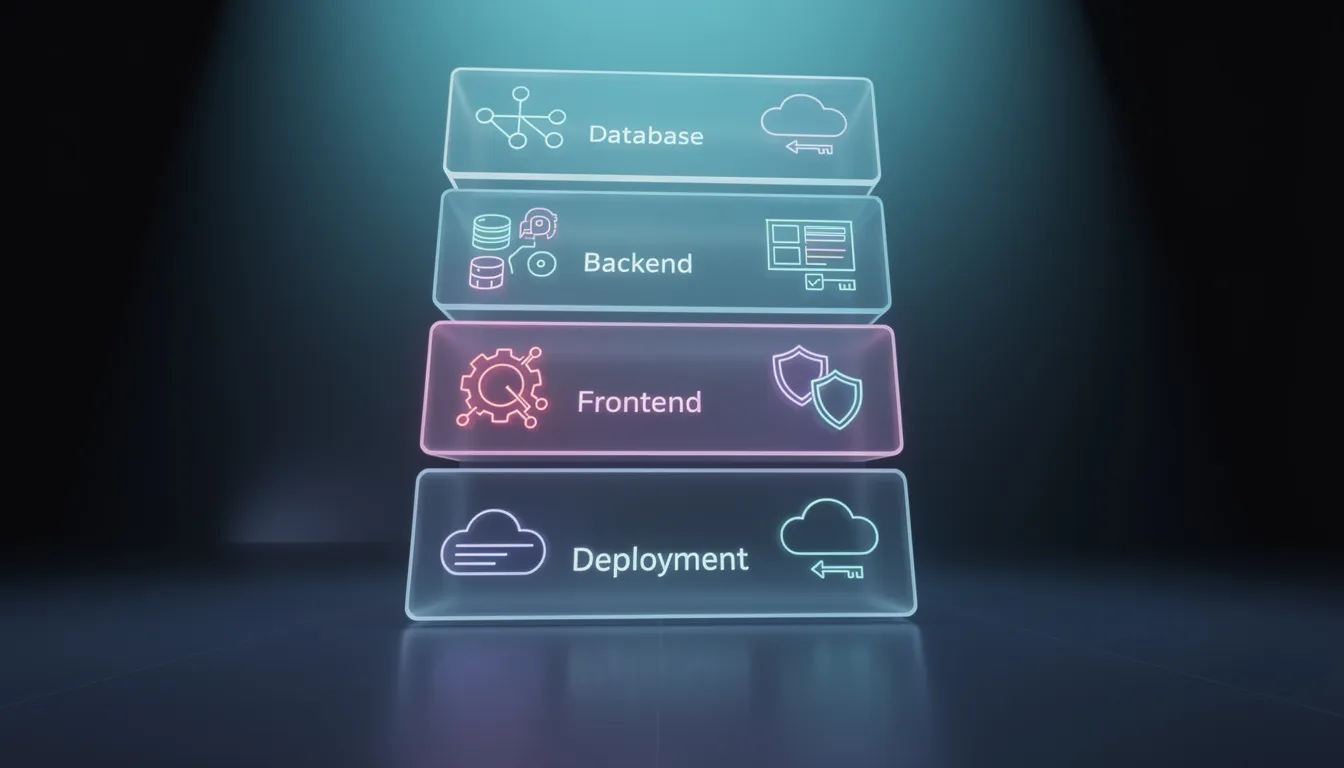
The tech stack you choose on day one shapes your velocity for the next two years. Choose too conservatively and you spend months re-inventing solved problems. Choose too experimentally and you are debugging bleeding-edge issues instead of building product. After shipping multiple SaaS products in 2025 and into 2026, this is the exact stack I reach for — and why.
This is not a theoretical overview. These are the specific tools, the versions that work, and the tradeoffs I have encountered in production.
Frontend — Next.js + TypeScript + Tailwind CSS
Next.js 14 with the App Router is the default starting point for any new web SaaS product. The combination of React Server Components, built-in routing, image optimization, and edge-ready deployment covers most frontend requirements without any additional tooling.
TypeScript is non-negotiable. The short-term cost of typing your data models pays back within weeks in the form of fewer runtime errors and much easier refactoring as the product grows.
Tailwind CSS handles styling. The utility-first approach pairs well with component libraries and keeps styling decisions local to the component rather than scattered across global stylesheets. For component primitives, I use shadcn/ui — not a library you install from npm, but a collection of accessible, unstyled components built on Radix UI that you copy directly into your project. This gives you full control over the implementation without fighting a vendor's design system.
The developer experience stack on top of this: ESLint for code quality, Prettier for formatting, and Zod for runtime type validation — especially for form inputs and API responses where TypeScript's compile-time guarantees do not reach.
Backend and Database — Supabase
Supabase is the backend layer that makes small teams capable of moving at the speed of large ones. It provides Postgres, authentication, file storage, realtime subscriptions, and edge functions — all in one platform with a generous free tier and reasonable scaling costs.
The Postgres database is the core. Unlike NoSQL databases that require you to design around query patterns upfront, relational data with Postgres stays flexible as your product evolves. You can add columns, restructure relationships, and write complex queries without schema gymnastics.
Supabase's Row Level Security (RLS) is worth understanding deeply. It lets you define access control policies directly in the database — so a query from a client can only ever return rows that the authenticated user is permitted to see. This eliminates an entire category of security bugs at the data layer rather than relying on application-level checks.
For more compute-intensive backend logic — complex business rules, third-party API integrations, webhook handlers — I run a lightweight Node.js service on Railway (covered below) alongside Supabase, rather than stuffing everything into Supabase Edge Functions.
Authentication — Supabase Auth vs Clerk
Supabase Auth handles authentication out of the box and is often sufficient. It supports email/password, magic links, OAuth providers (Google, GitHub, etc.), and phone/OTP — all integrated with the rest of the Supabase platform, including RLS.
For SaaS products with more complex multi-tenancy requirements — organizations, team invites, role management, enterprise SSO — I switch to Clerk. Clerk's organization model is purpose-built for SaaS and saves significant development time when you need per-seat billing, user impersonation, or detailed audit logs.
The rule: Supabase Auth for straightforward user authentication. Clerk when your product has organizational hierarchy or enterprise requirements from the start.
Payments — Stripe
There is no serious alternative to Stripe for SaaS payments in 2026. The API is mature, the documentation is exceptional, and the ecosystem of integrations is unmatched.
For SaaS specifically, Stripe Billing handles subscription management, trial periods, proration, invoice generation, and payment failure recovery — all of which are genuinely complex to build correctly. Stripe's customer portal lets users manage their own subscriptions without you building that UI.
The integration I use: Stripe Checkout for the initial payment flow (hosted by Stripe, no PCI scope for you), Stripe Billing for subscription management, and webhooks for keeping your database in sync with subscription state changes.
One practical note: implement your webhook handler with idempotency from day one. Stripe may deliver the same event more than once, and your handler needs to process duplicate events safely.
Email — Resend + React Email
Resend is the transactional email provider I use on every new project. It was built by developers, for developers — the API is clean, the deliverability is excellent, and the developer experience around email debugging is far better than legacy providers.
React Email pairs with Resend to let you build email templates as React components. This sounds trivial until you have tried to maintain HTML email templates in raw HTML. With React Email, your email templates get TypeScript support, component reuse, and a local preview server — you can see exactly what the email will look like in different clients before sending.
For marketing emails and newsletters (as opposed to transactional), I keep that separate — typically Brevo or Loops — to avoid mixing transactional and marketing sending reputation.
Deployment — Vercel + Railway
Vercel is the natural deployment target for Next.js. Zero-configuration deployments, preview deployments for every pull request, edge network for static assets, and deeply integrated Next.js-specific optimizations make it the best option for the frontend layer.
Railway handles backend services, worker processes, and any compute that does not fit into Vercel's serverless model. Long-running processes, background job queues, websocket servers, and custom APIs all run well on Railway. The pricing model (usage-based, not per-seat) scales reasonably for early-stage products.
The combination gives you a frontend on Vercel talking to Supabase and any backend services on Railway — all connected over private networking where needed.
Monitoring — Sentry + PostHog
Sentry for error monitoring. When something breaks in production, Sentry captures the full error context — stack trace, user session, request data — and surfaces it immediately. Setting this up takes under an hour and pays back the first time you debug a production issue in minutes instead of hours.
PostHog for product analytics and session recording. Unlike Google Analytics, PostHog is designed for product teams — funnel analysis, feature flags, A/B testing, and session replay are all built in. The self-hosted option is available if data sovereignty matters. For SaaS products, funnel tracking from signup through first meaningful action is essential for understanding where users drop off.
Both tools have generous free tiers that cover early-stage products comfortably.
What I Would Change for Different Use Cases
This stack is optimized for web SaaS products. Different requirements call for different choices:
Mobile applications. If the product needs a native mobile app, I add React Native with Expo for the client. The same Supabase backend works directly — Supabase has excellent React Native client libraries. Expo's build service handles app store submissions without requiring local Xcode or Android Studio setups.
API-first or high-throughput backends. For products where the backend is the core product — high-volume APIs, complex data processing, real-time systems — I replace the lightweight Node.js service with a dedicated Node.js + Hono service. Hono is a modern, edge-ready web framework with TypeScript-first design and excellent performance characteristics. It pairs well with Bun for maximum throughput on Railway or Fly.io.
Enterprise requirements. Products targeting enterprise customers often need SOC 2 compliance, SAML SSO, dedicated infrastructure, and audit logging. These requirements shift some of the component choices — Clerk over Supabase Auth for SSO, AWS or GCP over Vercel/Railway for dedicated infrastructure — but the core application layer remains similar.
High data volume analytics. If the product generates significant analytics data that users need to query — think data warehousing, BI features — adding ClickHouse (via ClickHouse Cloud) alongside Postgres handles the analytical workload that relational databases are not optimized for.
The stack above lets a solo developer or small team ship a production-grade SaaS product in weeks rather than months. Every component is chosen because it solves its domain problem well, integrates cleanly with the rest, and scales without requiring a full re-architecture.
If you are planning a new SaaS product and want to talk through the technical architecture — what to build, what to buy, and how to structure the system for your specific requirements — I offer a free technical scoping call.
Written by Mehdi Yatrib — Indie Maker & Consultant based in Casablanca, Morocco.
Work with me on Software Development