From 0 to 1,000 Users Without Spending on Ads
Paid ads at the early stage feel like growth. You put money in, signups come out. But the moment you pause spending, the signups stop too. You haven't built a growth engine — you've rented one.
Organic growth compounds. An SEO article published today drives traffic in six months and continues for years. A community presence built over 90 days generates warm inbound indefinitely. A partnership created this week can become a steady referral source for the next three years.
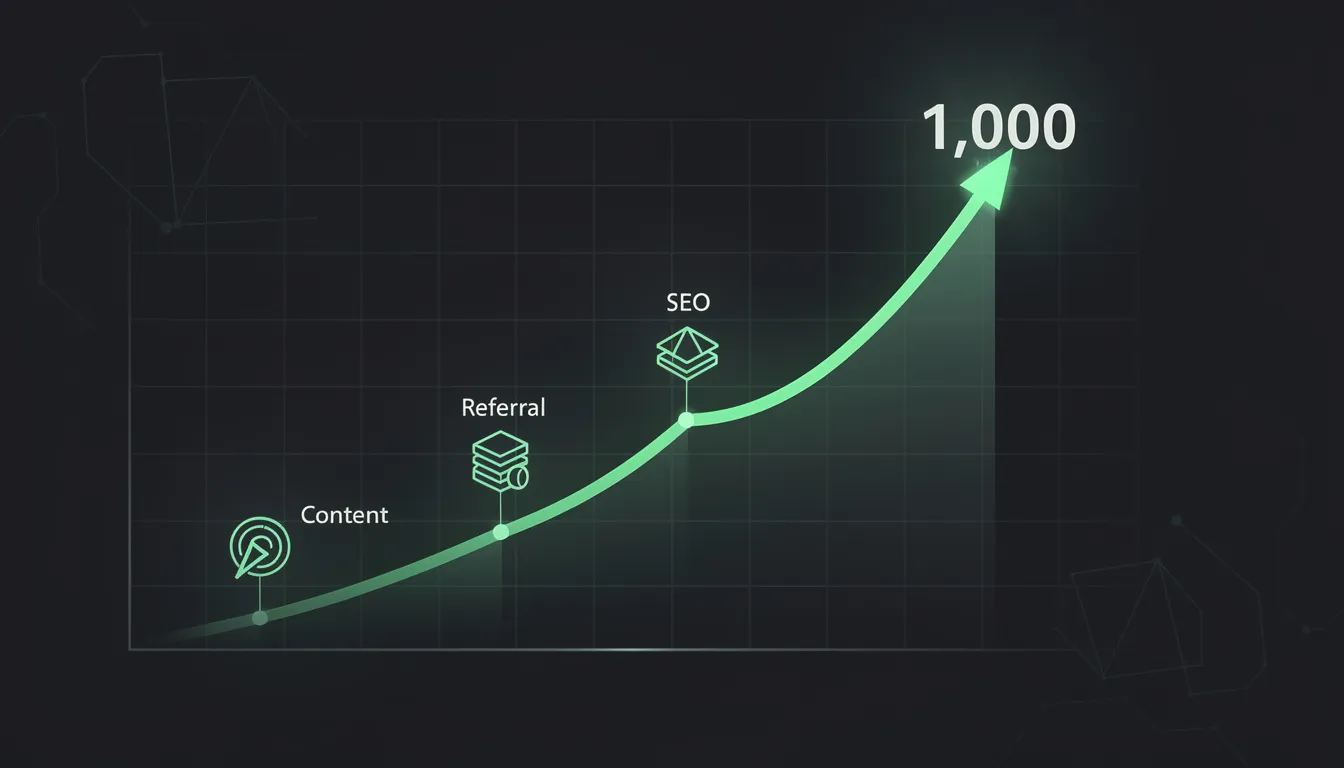
Getting from 0 to 1,000 users organically is slower at the start and faster in the long run. Here is the playbook.
Why 0–1,000 Is Different From 1,000–10,000
The 0–1,000 phase is not a growth phase — it is a learning phase. Your goal is not to optimize acquisition funnels. Your goal is to find out who your best users are, what makes them stay, and why they chose you.
This changes everything about your strategy. You should not be running ads to an unvalidated offer. You should not be hiring a growth marketer to optimize a funnel that does not yet convert. You should be talking directly to potential users, getting them into the product by any means, and learning obsessively.
The channels that work best in this phase are high-touch, personal, and scalable-once-you-understand-the-pattern. They are slow to start and powerful once you have the feedback to sharpen them.
At 1,000 users, you have a foundation: proof that the product works, data on what drives activation, and a clear enough ICP to start systematizing acquisition. That is when you scale.
The 6 Organic Channels That Work Before Product-Market Fit
1. Your Personal Network (LinkedIn, Twitter/X)
Your first 50 users almost certainly know you or know someone who knows you. This is not a bug — it is the fastest possible feedback loop. People who know you will give you honest reactions. They will try things. They will tell you what is missing.
Post consistently about the problem you are solving, not the product you are building. LinkedIn and Twitter/X reward perspective and insight, not product announcements. A post titled "Three things I learned after 60 conversations with [your ICP]" will get more reach and more qualified attention than "Our new feature is live."
Direct outreach to your first 50 connections with a personalized note and a specific ask ("Would you try this for 15 minutes and tell me what confuses you?") converts far better than a launch announcement.
2. Target Community Engagement (Reddit, Slack Groups, Discord)
Every industry has online communities where practitioners gather to ask questions, share tools, and discuss problems. Reddit subreddits, Slack communities (Product School, On Deck, various industry-specific groups), Discord servers, and Facebook groups are all channels where your ideal customer is already spending time.
The approach that works is contribution before promotion. Spend two weeks answering questions, sharing useful resources, and being genuinely helpful before you mention your product at all. When you do mention it, do it in response to a specific problem where your product is a direct solution — not as a general announcement.
Communities ban self-promotion. They reward members who make the community better. Be the second thing, and the first thing takes care of itself.
3. Cold Email to Ideal Customer Profile
Cold email has a reputation problem because most people do it badly. Spray-and-pray campaigns to purchased lists with generic copy produce <1% reply rates and damage your domain reputation.
Done correctly — targeted list, hyper-personalized opener, specific and credible ask — cold email consistently produces 15–30% reply rates and is one of the fastest ways to get qualified conversations.
The formula: research your ICP carefully (job title, company size, specific context), identify 50–100 highly targeted prospects, write an email that demonstrates you understand their specific problem, and make an ask that is low-friction (a 15-minute call, a free trial link, feedback on a concept).
Do not pitch your product in the first email. Open with the problem. Let the reply be the invitation to pitch.
4. SEO Content Targeting Problem-Aware Keywords
Most early-stage SaaS teams try to rank for product-aware keywords ("best [category] software"). These are competitive, slow, and attract users who are already comparison shopping.
Problem-aware keywords are where you win early: "how to [painful process your product solves]", "[problem] without [current bad solution]", "best way to [job-to-be-done]". These searchers know they have a problem and are looking for solutions. Your content can both solve their immediate information need and introduce your product as the tool.
The play: write 10 high-quality articles targeting specific problem-aware queries. Each article should genuinely solve the problem in the content and include a logical, low-friction introduction of your product as a tool. Prioritize articles where you can realistically rank in the top 3 within 6 months (low DA competition, clear search intent, specific query).
5. Product Hunt, AppSumo, and Directories
Product Hunt launches are a specific event that can generate a concentrated burst of early users — 100–500 signups in a 24-hour window if done well. The key is preparation: building an audience before the launch (via newsletter, LinkedIn, community), getting upvotes from your genuine supporters in the first two hours (the algorithm favors early velocity), and following up every comment personally.
AppSumo deals can drive significant user volume if your product is a fit for their audience (productivity tools, marketing tools, developer tools for small businesses). The trade-off is a heavily discounted lifetime deal — but the learning, the reviews, and the word-of-mouth from 500 lifetime customers can be worth it.
Directories — G2, Capterra, Product Hunt as a permanent listing, Indie Hackers, Betalist — are long-tail sources that produce consistent low-volume inbound if your listing is well-optimized.
6. Partnerships with Complementary Tools
Find the tools your ideal customers already use and build relationships with their teams. A partnership can be as simple as a mutual mention in each other's newsletters, a co-written piece of content, or a native integration that appears in their marketplace.
Integrations in particular are high-leverage. If your product integrates with a tool your customers use daily, appearing in that tool's integration directory puts you in front of a highly targeted audience at zero marginal cost. Build the most impactful integration for your ICP, get it listed, and optimize the listing.
The Weekly Growth Engine
Once you have identified which one or two channels are producing results, systematize the work:
Every week:
- Publish or update one piece of SEO content
- Make 10–20 targeted outreach contacts (cold email or community contribution)
- Post 3–5 times on LinkedIn or Twitter/X with problem-focused perspective
- Have at least 2 user interviews or feedback conversations
- Review your signup data and trace your best users back to their acquisition source
The goal of the weekly engine is not scale — it is consistency. Compounding requires showing up every week for months, not sprinting for two weeks and burning out.
What to Measure in the First 90 Days
In the 0–1,000 user phase, your most important metric is not total signups. It is quality of signups.
Track:
- Activated users — Users who reached your defined activation event (completed the key action that defines engagement). This is more meaningful than raw sign-ups.
- Source-by-source activation rate — Which channels produce users who actually use the product? Cold email users might activate at 40%; Product Hunt traffic at 15%. This tells you where to focus.
- Weekly retention cohorts — Of the users who signed up in week 1, how many are still active in week 4? This is your honest product-market fit signal.
- Qualitative feedback volume — How many user conversations did you have this week? At this stage, qualitative data is as important as quantitative.
When to Add Paid Acquisition
Add paid acquisition when: your organic channels have validated the ICP, your activation rate is 30%+, your week-4 retention is 25%+, and you understand the acquisition cost you can sustain based on your average revenue per user.
If you turn on ads before these conditions are met, you are buying data about a product that does not yet work. The same money, spent on user research and iteration, would produce more valuable information.
Paid acquisition amplifies what already works. It does not fix what is broken.
Getting from 0 to 1,000 users organically requires patience, consistency, and a genuine interest in talking to your potential customers. It is slower than writing a check for ads and faster than building something nobody wants.
I'm Mehdi Yatrib, a growth marketing consultant based in Casablanca. I help SaaS founders build their first 1,000-user base through structured organic growth strategies — no ad budget required.
Written by Mehdi Yatrib — Indie Maker & Consultant based in Casablanca, Morocco.
Work with me on Growth Marketing